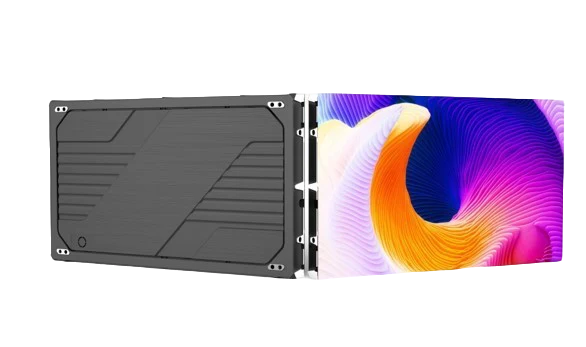
A wall-mounted display has to fit the room and remain serviceable after installation. Before requesting a quotation, describe both the visible screen and the space around it. Cabinet dimensions alone do not explain how a technician will reach a module or how the completed image will fit the architecture.
Start with the screen and the room
Send the intended display width and height, the indoor location and a drawing of the mounting surface. Include the nearest viewing position and examples of the content: presentation slides, video, text or a combination. These details give the supplier a concrete brief for discussing the display configuration.
Mark any fixed edges, recesses, doorways or corners on the drawing. If the screen turns through a corner, show both faces and identify the active display area. A reference photograph is useful alongside dimensions, but should not replace them.
Confirm the maintenance direction
BLC’s BH and BN COB materials describe front maintenance, HUB hard connections and system-backup support. The indoor BT family also uses a front-service design. The T3-PRO range adds magnetic module mounting and configurable cabinet arrangements.
When discussing these options, ask which components can be reached from the front and what clearance is needed for removal. Agree on the access route for power and signal connections as part of the installation plan.
Choose the cabinet arrangement
A modular wall is assembled from physical cabinet sizes. Some ranges offer mixed cabinet combinations; others use a more uniform format. The BN and BL materials describe combinations of different sizes, while T3-PRO lists horizontal and vertical arrangements using several cabinet formats.
Ask for a proposed cabinet layout showing the finished screen dimensions. Confirm the orientation, service direction and any corner parts together, rather than selecting them independently.
Put the required configuration in writing
- Overall screen width and height, with a dimensioned installation drawing.
- Indoor location, mounting method and available service space.
- Content examples and intended audience positions.
- Cabinet layout, maintenance direction and control-system requirements.
- Any required backup configuration, spares and acceptance documents.
Use the approved configuration for the final quotation. Product-family features are a starting point; the selected model and options should be identified explicitly.
Discuss your display brief
Explore our cob led displays or send a project inquiry with your intended dimensions and installation details.